Showing posts with label edubloggerworld. Show all posts

EduBloggerWorld, Helping Others, and the Business of Education

EduBloggerWorld (EBW) is dying.

With Ning's announcement several weeks ago that they would be moving toward a pricing structure that doesn't provide free services to networks with more than 150 members, we're not sure how we won't be forced to close the doors and gently nudge EBW's members to another network. What's worse, it feels like it's the network that's really tying all of EBW's 1,600+ members together, given such a wide distribution of varying national representation. I would estimate that less than 5% of EBW's members have ever met face to face.

As a result, I'm doubtful that large pockets of members will shift spaces together and sadly suspect that closing the doors to EBW will mean the end of many meaningful relationships forged on the site. Sure, there's Twitter, Facebook, Classroom 2.0, and the blogosphere itself, but the membership of EBW seems to occupy a niche of international flavor not openly expressed, emphasized, nor embraced in other spaces.

Honestly, I'm torn by many things related to this turn of events. First, I'm frustrated by Ning, Pearson, and the commercialization of education. One walk through the vendor floor at any major conference and you can tell that education now means big bucks. If we truly believe that education is for the benefit of greater society, then why don't more companies give more for our future? I think Wikispaces, for example, has set a very good example along these lines - as Ning once did. But Ning's sell-out to Pearson frustrates and saddens me, all at the same time.

The big business of education, clearly evident at ISTE.

A second area of trouble for me in this regard is that of focus. While my job now consumes much of my time and requires me to focus sharply on the needs of teachers and students in my District (and rightly so), I still feel strongly that the key to our future success depends greatly on how much we're willing and how well we're able to help and work with others outside our immediate sphere. Honestly, I think the answer to the question I posed during Richard's ISTE keynote (shared below) is a resounding "YES!"


If those of us living in favorable circumstances don't take the time to make the effort to help those less fortunate, then how can we say, at the end of the day, that the sum of our efforts has been a success?

I'd love to hear your thoughts on how we might save EBW or your predictions on what will happen to the communities formed in the network after its demise.

Bloggers Who Create Community

Sue Waters from the Mobile Technology in TAFE blog presented me with the Bloggers Who Create Community Award! The purpose of this award is to show gratitude to bloggers whose focus is on building communities.


Here is what Sue had to say:

Lets be honest — giving Darren an award, with any type of rule attached, is a frightening thought because he is well known for changing rules and is incredible funny. But those who know him well would agree he totally deserve this award for all his edublogger community support and his work with the Global Open Professional Development - Social Software in the Classroom. I am humbled by Darren’s incredible diplomatic skills in the global community.
Sue, you are one that really deserves the award. The example you have set for teachers throughout Australia and the rest of the world is highly commendable. Therefore, thank YOU for making our community far more worthwhile.

Tracing the award back, I was able to find a number of extremely fascinating stories from people around the world:
At which point I lose interest (or time, rather) in following the trail. Nevertheless, in perusing the list alone you're able to glimpse how very small our world has become - and how different community is today from yesterday. Yesterday, community was generally local. Today, it's global.

In order to conform to rules established by previous award recipients, I will now list three bloggers (among many) that I have found to be tremendous in their abilities to build community.

Bloggers Who Create Community

Steve Hargadon

I doubt that anyone would argue with me when I say that Steve Hargadon has done more to encourage and enable community among educators - or at least online community in the form of social networking - than any other person. The creator of Classroom 2.0 and a number of other educational social networks, I would be surprised if Steve's full name isn't Steve Community Hargadon.

The Alec Couros / Dean Shareski Twitter Tag Team

I'm amazed at how well these two Twitterlebrities are able to include others in their conversations and connections. Whether it's a quick ad-hoc session to learn a new tool or just a simple conversation, these two are ever willing to share and include others. Alec and Dean represent many bloggers in my Twitter community that make being a part of Twitter educational, enjoyable, and veritably rewarding. One of Dean's policies related to both his blog and Twitter, for example, speaks highly to this end:
Another new policy: anyone who takes the time to comment on my blog, I automatically follow in twitter. It only seems fair.
Lisa Durff

Durff is absolutely amazing. Sincere and genuine, I'm so appreciative of how well she is able to include others in learning throughout the communities with which she participates. I've said it before and I'll say it again: We need to clone Durff and place several copies in every school around the world.

Runners Up

Now, it appears that one of the purposes in passing along this award is to thank others - that have been so effective in promoting community - for their efforts. Thus, I would be remiss if I didn't continue to list a few more bloggers - in no particular order - for whom I am grateful.
  • Robin Ellis - Thanks, Robin, for all of the time you've spent to further the cause. For those of you that don't already know, Robin is continually promulgating community throughout her many circles.
  • Patrick Higgins - Thanks for promoting community among your teachers in New Jersey as well as throughout the world (we'll boost your new Technorati ranking just yet).
  • Jennifer Jones - Thanks for the hilarious tweets. I'm actually kind of glad that you caved. +10pts.
  • Suzanne - Thanks for your efforts in promoting community among those at EduBloggerWorld.
  • Stephanie Sandifer - Thanks for being such a great example for edubloggers, teachers, and principals alike - in Texas and throughout the blogosphere.
  • Chris Brogan - I've got to say thanks, personally, for your Google Reader shared items - in addition to thanking you for taking the time to so effectively promote community. I don't know how you find it all, but the items you share are fantastic.
  • And, of course, the list could go on and on and on...
Technorati Tags:

One Small Step For Google

Hello Google,

When I mentioned that I hoped that you took the idea of translation bots one step further, this is pretty much what I had in mind:

Please note:

  • I have written in English while Jorge has written in Spanish.
  • I have chosen my language using the pull-down menu.
  • I can see what language my friend is speaking, but am not troubled with the clutter caused by multiple translations of the same content.
  • An optional "View untranslated conversation" button might also be a good addition - both providing an exchange similar to what you currently have in place and limiting the phrases that might be lost in translation, given that a person can read the foreign language but prefers to type in his/her native tongue.
Again, one small step for Google, but one giant leap for mankind - or at least those of us concerned with international communication.

Have a nice holiday season,

Darren

Technorati Tags:

Social Network Preferences

Question: "What is your favorite social network?"
Audience: Mostly educators
N = Roughly 50
Highly Scientific: Duh


Nevertheless, I'm in agreement with the findings. My favorite social network is also Twitter. I enjoy:

  • The conversation
  • The randomness
  • The sense of community
  • The human, personal nature of the network
One thing I don't like about Twitter: I absolutely hate it when Twitter eats my tweats. Little is more frustrating than to realize that you've missed out on a part of the conversation. What's that you ____ saying about ____?

My take on the others:
  • Ning - Great for classes, events, or other activities that can benefit from a focused discussion forum. One thing I don't like: It's usually a little choppy.
  • Facebook - I love Scrabulous and Chess. What's not to like about asynchronous play? Except losing all the time.
  • The Blogosphere - This is a social network that can eat up hours of time, every day, if you let it. Interestingly, not many people consider (or remember to consider) the blogosphere as a social network.
Technorati Tags:

Social Software 07 Rocked The House

Last night's Social Software in the Classroom open professional development class went as well as I had envisioned it could go from the beginning. To say that it went perfectly would probably be an understatement:

  • Recording, transmission, and connecting went flawlessly.
  • We opened with the first "show & tell" session that I know of that has included teachers from across the country. The topic: Bring your favorite Firefox plugin.
  • We continued with a wonderful discussion about the in-class use of various exciting, online teaching tools.
  • After a brief break, we were happy to interact with our first international guest speaker. Rachel Boyd (from New Zealand) was kind enough to explain to our class about a few of the experiences she's had in using blogging as an educational tool for her students. How many guest speakers from New Zealand have you brought into your class lately? +10pts to Rachel for her willingness to share.
  • Finally, Rachel's discussion led perfectly into a discussion about blogging. We used Blogger as our tool of choice, simply because the participants already had Google accounts and the Blogger interface is relatively easy to use.
  • In total, roughly 35 teachers from around the world participated in our class.
  • It's been amazing to see how far we've come in 5 short weeks, and am glad that we were able to shine in this final session.
  • None of this would have been possible without educational social networking! Classroom 2.0, EduBloggerWorld, FaceBook, and especially the Twitter network (my TwitterSchool) have been able to come together to make truly great things happen.
Again, the entire class was extremely refreshing, and I'm confident that everyone that participating walked away from the night having learned much.


Click here to view the video and audio recorded during the class to read about how we accomplished it all.

Technorati Tags:

What It Means To Participate In EduBloggerWorld

At first I was disappointed. Then I better understood reality. When I first saw Suzanne's forum post on the newly created EduBloggerWorld ning, I wasn't sure exactly how to respond.

Why is it that teachers seem so reluctant to utilise this amazing learning/sharing/social opportunity? I think that edublogger world has huge potential, but I am concerned that my patience will not last till that potential is fulfilled.
Suzanne was, in part, expressing a frustration that there are times when the EduBloggerWorld ning appears to have relatively little participation. And you know what? She's partly right. There are times when the ning may feel a little empty.

Emptiness on the ning, however, does not mean that our community members aren't participating.

As a community of educational bloggers, I think that we need to make sure that our priorities are straight:
  1. Twitter
  2. Blogs
  3. EduBloggerWorld Forums
  4. Our students
In that order. That way we can make the most of our time online.

And while I may be kidding about listing our students last (yes, they should be at the top of our lists), I do think that we often forget that most of the members of our community were bloggers long before they were ning participants (and rightly so). As a result, I recommend the following:
  • Take a little time to read other members' blogs. You may find them through Google, Technorati, or in our EduBlogger listing of Member Blogs.
  • While you're on the Member Blogs page, go ahead: add yourself to the list.
  • Probably the best way to encourage EduBloggerWorld participation is to simply participate yourself. Using the EduBloggerWorld forums to comment on other member's blog postings would probably bring them in, as well.
  • Finally, when you choose to write on your blog about something that you think would benefit the entire EduBloggerWorld community, please tag your posts using the appropriate EduBloggerWorld tag. This list of tags is being maintained by our community.
So here's to the continued growth of a valuable community. May the force be with us all.

Image Source - 1

Technorati Tags:

The EduBloggerWorld Second Virtual Meetup

On behalf of the entire EduBloggerWorld community I would like to invite you to participate in the virtual meet-up that will take place on September 18, at 9 p.m. EDT. To view what time that is in your time zone, click here.

In this, our second meet-up, Vicki Davis will be hosting the Women of Web 2.0 webcast on EdTechTalk. The main topic of discussion for this episode will be “Non Traditional Professional Development”. Guests on the show will include Dean Meyer, Steve Hargadon, Julie Lindsay, and myself. Your participation will also be encouraged as interaction with participants in the accompanying chat-room is always an entertaining addition.

If you have never participated in an EdTechTalk discussion before, you may want to visit this page ahead of time to ensure that you’re up to speed before the discussion begins.

We hope to see you soon!

Technorati Tags:

The Infinite Typing Monkeys

During the past several weeks, several events have transpired, leading to this strange blog post.

  1. I've been exploring various social networks, trying to determine if any educational value can be found within.
  2. I've nearly finished reading Andrew Keen's The Cult of the Amateur.
  3. School has started up again in my District, leaving teachers and students in a mad scramble to find the time to accomplish all that must be done.
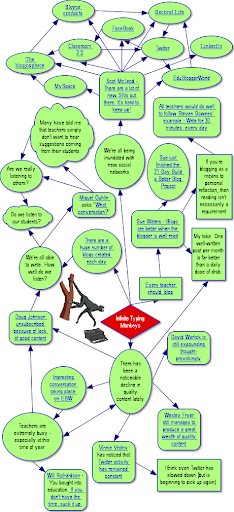
That said, as I initially sat down to write about my feelings, I found the linear nature of written text to be far too cumbersome to truly express the inter-connectedness of what I had hoped to say. As a result, I've decided that a more effective way to present my thoughts might be in using the classic graphic organizer. What you see below is the result.

The EduBlogger March of the Penguins


It will be helpful for you to understand that I began my "rapid-fire" of thoughts while concentrating on the chilling words with which Keen has chosen to open his new book (emphasis my own):
I've spent the last two years observing the Web 2.0 revolution, and I'm dismayed by what I've seen.

I've seen the infinite monkeys, of course, typing away. And I've seen many other strange sights as well, including a video of marching penguins selling a lie, a supposedly infinite Long Tail, and dogs chatting to each other online...

I call it the great seduction. The Web 2.0 revolution has peddled the promise of bringing more truth to more people—more depth of information, more global perspective, more unbiased opinion from dispassionate observers. But this is all a smokescreen. What the Web 2.0 revolution is really delivering is superficial observations of the world around us rather than deep analysis, shrill opinion rather than considered judgment. The information business is being transformed by the Internet into the sheer noise of a hundred million bloggers all simultaneously talking about themselves.

I have strongly mixed thoughts about Keen's message.

On one hand, while harsh in his judgment, I find Keen's words to be hauntingly truthful. I worry that we have become a society obsessed with being heard - hoping to find some semblance of audience - often not taking the time ourselves to listen to others. I seriously question:

  • Do we listen to our students?
  • Do we listen to our readers?
  • Do we even listen to ourselves?
On the other hand (and in contrast), aren't there justifiable times when teachers should post to their blogs without listening to others ahead of time? I personally think that if you're using your blog as a tool for reflecting on your classroom practices, then additional reading may not be needed (the lack of which should at least not prohibit you from writing).

Either way and when all is said and done, I'm happy to be counted among the infinite typing monkeys and hope that teachers all around the world will continue to join in on the madness.

Technorati Tags:

Eliminate The Digital Divide? It's up to you...

Recent comments on this blog, as well as several emails recently received have left me thinking more about the infamous Digital Divide. Admittedly, there exists such a chasm - a quick glance at the participants involved in the newly created EduBloggerWorld social network can attest to that glaring fact.

Even from this crude representation of global Internet activity, the glaring absence of participants from Africa is absolutely staggering. So I heartily admit it: The Digital Divide is real.

Nevertheless, the Digital Divide isn't what keeps teachers in my district from using technology with their students. Nope. That honor would go to two huge F's that exist within the personalities of many Jordan School District teachers: Fear and Fatigue. While there are certainly many excellent teachers in our district, there are also many teachers that are afraid to try anything new in their classes. An even larger population are too tired to take the time to learn new techniques and technologies.

"Why _____ when what I've been doing has worked for years?"

Hence, Pay Attention was born - because, truth be told, the teachers in our district have a plethora of technological resources at their fingertips (labs, computers, technology a plenty). The choice to eliminate the Digital Divide that may or may not be present within their classrooms is theirs, and theirs alone.

In other places, however, such technological (also translated: pedagogical) autonomy for teachers and students sadly doesn't exist. The teacher in Nigeria doesn't use technology with her students because it's non-existent (at least within a 100 mile radius) - not because she's chosen to leave the laptops locked up in the hall closet. And the sad fact of the matter is that such a divide will continue to exist until the "Haves" chose to give a little of their bounty to the "Have nots".

Like it or not, there is no other way.

That said, however, I don't think that the entire process of eliminating the Digital Divide has to be completely painful. Here's one solution that I think has definite potential, given that participants actually choose to eliminate the divide, rather than direct once-used funds in some other direction:
According to the COSTP website:

COSTP will employ the advantages of open sourced content and innovative licensing tools to significantly reduce California's K-12 textbook costs — eventually turning K-12 curriculum and textbook construction from a cost into a revenue generator for the State of California.

Three - amongst many — COSTP benefits will be 1) the complete elimination of the current $400M+ line item for California's K-12 textbooks; 2) a significant increase in the range of content afforded to California's K-12 textbooks; 3) a permanent end to California's textbook shortages; and 4) creation of fully portable content holdings database that scales with classroom technologies as they are introduced.

It is important to note that COSTP's mandate does not replace printed textbooks; it simply makes them less expensive to produce; and, in doing so creates many additional benefits, economies, and efficiencies that will fully leverage California's activities in the K-12 textbook publishing domain.

If COSTP can really save California anywhere from $200 to $400 million dollars in textbook costs, let's do it everywhere - then divert saved funds in the direction of those students/teachers/countries with greatest need.

Granted, even after several years, the COSTP project is still in its initial stages. Nevertheless, I can't help but think that Open Source is the answer. Again, if the Digital Divide is to be narrowed, those of us that are actually reading this post (and posts like it) must be the ones to make it happen. There is no other way.

Technorati Tags:

EduBloggerWorld - Initial Meetups

Things are shaping up nicely at EduBloggerWorld. As on online community for educational bloggers around the world, we're approaching 285 members (representing somewhere around 48 different countries), and have experienced tremendous activity from several "sub-communities" within our community. It's all very exciting.

I'm please to announce that there have been several virtual meet-ups scheduled. The first will take place on August 23. Various activities have been planned throughout the day (some synchronous, some asynchronous) and on a variety of platforms. This will be an excellent way for members of the community (and potential members) to become better acquainted and discuss educational issues emanating from their location. Please visit the EduBloggerWorld wiki for a listing of specific activities, times, and virtual locations.

A second event has also been scheduled for September 18 using the interactive platform implemented at EdTechTalk. Additional details are forthcoming.

As an introductory explanation of the purposes and functions of EduBloggerWorld, we've created this brief video. All in all, it's pretty good - as long as you skip the last 30 seconds. : )


In conclusion, if you are a blogger that is passionate about education (wherever you might reside), we'd love to see you at EduBloggerWorld.

Technorati Tags:

“We’re at the very beginning of a huge shift.”

David Warlick led a session during EduBloggerCon 2007 that was extremely enlightening and by now, landmark. As a result of the enthusiasm felt in that session and subsequent relationships that were formed following that initial introduction, I have been reflecting further on the read/write web and its implications for the future of education.

To begin Mr. Warlick’s session he asked a simple question: “What is working?” Answers varied from brief one-word answers to elaborate descriptions of effective practice. I took fairly comprehensive notes during the session that I have yet to publish. As the content was very thought-provoking, I felt that it would be helpful for all to benefit from the discussion we had. My notes follow.

What is working:

  • Wikis – An example of this is the EduBloggerCon wiki. This entire event was planned thereon.
  • Online collaboration – School systems are getting together and sharing resources. –Diane Hammond
  • Because of new Web 2.0 tools, students and teachers are progressing toward a new learning environment –David Jakes
  • Students can show competence.
  • Digital cameras, interactive whiteboards – Teachers are starting to engage.
  • “The digital camera is the gateway drug [of educational technology].” –Mark Wagner
  • “What should the classroom of today look like?” –Steve Dembo
  • The classroom of today is a tandem classroom, paired with another classroom of another culture. –Hence the need for increased community (like EduBloggerWorld).
  • “It’s all about connections.” –Vicki Davis
  • “Start where you’re comfortable.” –Vicki Davis
  • “I have some students that - what goes on in schools stays in schools.”
  • “Now that we have all of this data on our students, what is there in the long tail for education?” –Doug Johnson
  • “The school of the future doesn’t concentrate on tools – because the tools are constantly changing. The school of the future concentrates on the learning.” –Sheryl Nussbaum-Beach
  • “Kids need to know how to choose which tool – because there are so many…” –Scott Merrick
  • “Smart classrooms have to be more than just the hardware – it’s a philosophical change about what happens with the tools in the classroom.” –Jeff Utecht
  • “We’re at the very beginning of a huge shift.”
  • “The smart classroom is the classroom that becomes a conduit for connections.
  • “In the smart classroom, the technology’s not integrated, it’s integral.” –David Jakes
  • “Social networking is going to be an integral part of the school of the future.” –David Warlick
  • Should it be called “Student Networking” instead of “Social Networking”? –Vicki Davis
Image Source - 1

Technorati Tags:

Pay Attention - On A Global Level

Exciting things are happening out there. Very exciting things.

Those of you that attended this year's EduBloggerCon "un-conference" in June remember that it was an amazing way to begin this year's NECC. Because not all bloggers were able to attend EduBloggerCon, we have created EduBloggerWorld - a Ning social network designed to facilitate connections and community for educational bloggers worldwide, serving as a first step toward future virtual events similar to EduBloggerCon.

Less than a week old, EdubloggerWorld is growing rather quickly (over 100 members in less than 5 days - with no formal advertising). Comparatively, there are more EduBloggerWorld members now (115) than there were attendees of EduBloggerCon (104) in Atlanta. Interestingly, communities within the community have also sprung up - with the creation of several groups including a Spanish bloggers group that has written several posts to the community in Spanish.


On behalf of Steve Hargadon, Julie Lindsay, and Vicki Davis, I write inviting you to join us (http://www.edubloggerworld.com/). We think this is an important step in embracing the international culture of a flattening world and an excellent way to pay attention to the world around us.

Technorati Tags:

The EduBloggerCon Community - Diversifying

Well it's official. Or as official as any "un-conference" can be.

I just finished a chat session with three of the smartest people I've entered a Google Talk session with. Alright, it was my first time using Google Talk, but they are pretty smart.

Julie Lindsay, Steve Hargadon, Vicki Davis, and I discussed a few of the formalities surrounding an international version of EduBloggerCon. In our discussion, we decided it would be best to allow for asynchronous communication - accompanied by occasional "live" sessions - dates and methods to be determined later. What's the name of all this madness, you ask?

EduBloggerWorld - coming to a Ning near you. Steve has done an excellent job in creating an online community in which we can all participate - the official URL of which is http://www.edubloggerworld.com/. It is our hope that this site will serve as the home and planning location for future, international versions of EduBloggerCon.

There's no turning back now.

Technorati Tags:

Creative Commons License
Original content distributed on this site is licensed under a
Creative Commons Attribution-Noncommercial-Share Alike 3.0 United States License.